US and Japanese Cultural Legacies from the 1980s and Beyond
The US and Japan during the 1980s
The United States and Japan share a “work hard, play hard” mindset that is culturally distinct. United States Exceptionalism drives the free market of capitalism and the idea that an individual works hard for himself and that his own work results in the company staying profitable. In contrast to this American exceptionalism, is a Japanese businesses approach which, used in the 1980s, employed an almost familial bond system that results in a highly structured and hierarchical system. By starting with comparison of these business styles in the 1980s “Trade War” and beyond , what emerges as we explore how Japanese culture influenced the US from the 1980s to the 2020s in ways beyond business.
The different business styles used by America and Japan would result in the US auto industry falling behind in production which produced an anti-Japanese sentiment felt first in Detroit through the automotive industry, and eventually spreading to a national level as the two nations enter a trade war built on perceived inequalities in trade. 1
Humbled Empire to Rising Nation
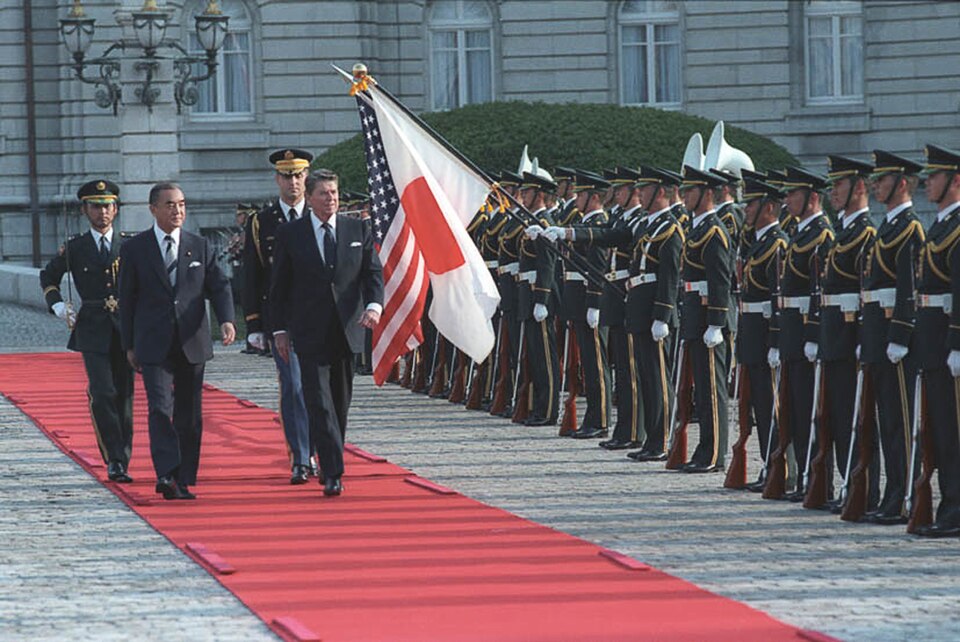
President Reagan and Prime Minister Nakasone arrival ceremony, 06 May 1986.
From 1945 to the late 1970s, Japan would emerge from an enemy defeated in World War 2 to a global economic competitor. This site will explore some of the economic and cultural ideas that drive both nations while also examining how these cultural differences were portrayed in the 80s. The site will then explore how Japanese culture influenced America during the 80s and beyond. What emerges when examining their cultures is that both countries seem to share the idea that there is something exceptional about its members that makes them destined for success with Japan focused on community framework while America following the individualistic pursuits.
United States Exceptionalism drives the US free market of capitalism and the individuals work hard for themselves and a belief that their own work results in the company staying profitable. Their effort in work also results in having the economic means to spend his leisure time on various ways that might include Japanese cultural products consumption. The Japanese businesses of the 1980s contrasted this by employing an almost familial bond system that results in a highly structured and hierarchical system, with leisure time of a Japanese “salary man” having a required portion of time spent with drinking with coworkers.
Cultures Competing since World War 2
As America was exiting the energy crisis of the late 1970s, Japan was starting its rise to economic superpower as it doubled automobile production and exported 40% of them to the US.2 In the midst of this rise, racism towards the Japanese, also caused by being seen as a former enemy of the US during World War 2, was also prevalent in the America. This discrimination has been around since the first and second generation Japanese started moving into America and continues in the stereotyping portrayal of the Japanese in US media.34
In this website, We will explore how this Japanese stereotype is portrayed, how self-perceived United States Exceptionalism clashes against the core ideas within Japanese identity and how these identities relate in business, movies and animation. The last section will lightly cover how the Japanese company Nintendo successfully infiltrated the American Market to become a highly popular business.
Business
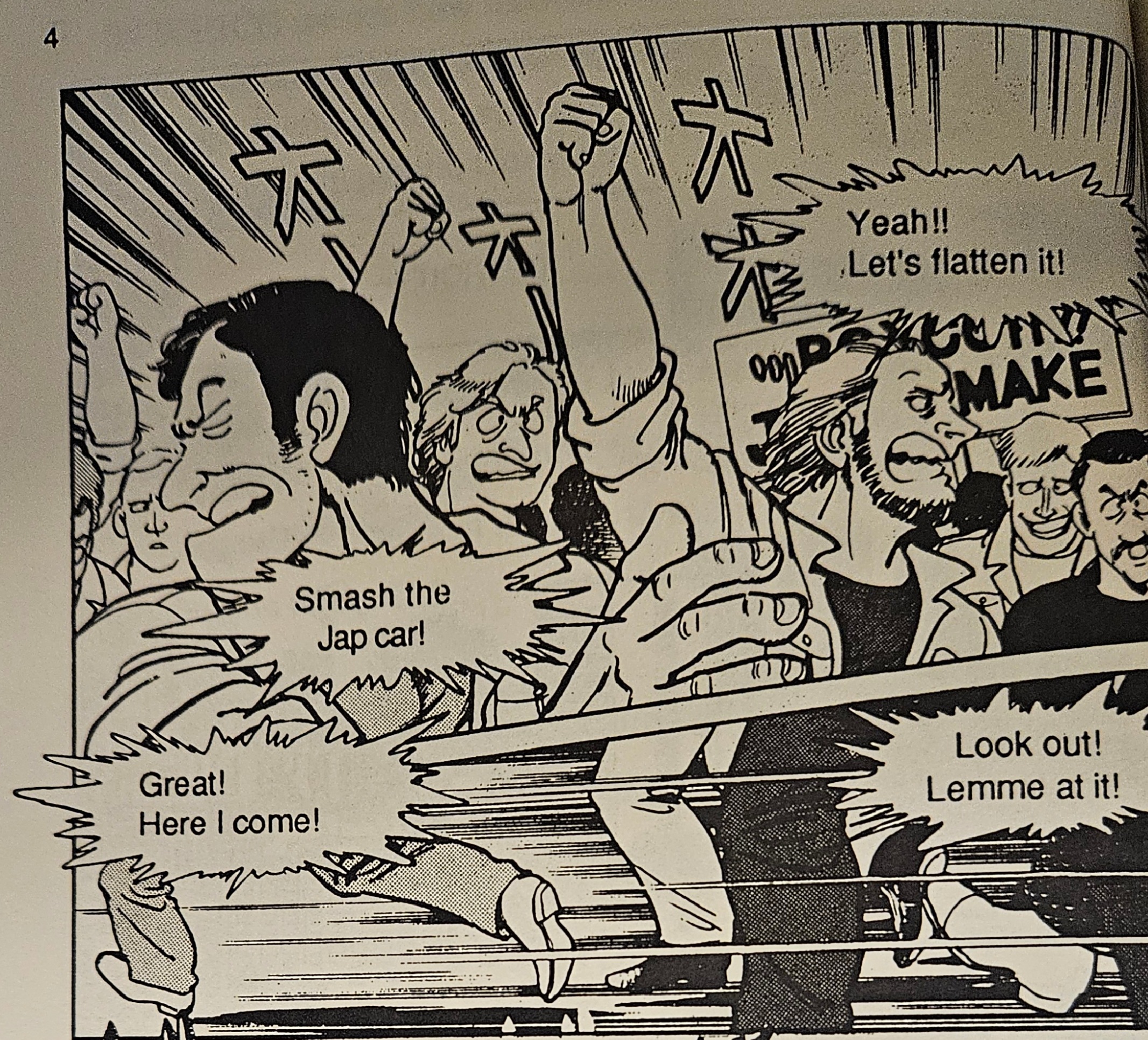
Japan Inc’s portrayal of the UAW union’s outrage
There are fundamental aspects of culture that America and Japan differ. These differences lead to their business styles having to adjust when interacting. The Japanese adjusted to the oil crisis with fuel efficient cars which led to a counter movement of “Buy American.” The nature of UAWs push to “Buy American” itself was acknowledged to possibly produce an anti-Asian sentiment within the United Autoworkers Union but American outrage at the Japanese producing more cars was met with the reality that American consumers were recovering from the 1970’s oil crisis and therefore wanted these more fuel-efficient cars.
Going Global: The Lasting Impacts of the 80s
Thirty years after the trade war ended, Japan would continue to have a lasting impact on American Culture. From business practices, entertainment and exported cars, Japan continues to exert its cultural soft power on the US. The underlying racial tension that existed in the 1980s has decreased in certain groups from a better understanding within certain entertainment industries, such as videogames and anime, as the result of US increased consumption of Japanese media. As a consumer of Japanese media, The US acts as a melting pot, absorbing various technology and culture from Japan, such as Studio Ghibli’s popular movies and Sony’s PlayStation game consoles, while also fusing aspects of Japanese culture into America popularity such as movies like Pacific Rim and Godzilla v King Kong.
By looking at the trade war and the anti-Japanese sentiment that it generated, we see that the US and Japan have had a push and pull relationship in their cultures. The US was pushing away in the late 70s to mid-80s but then started pulling in the aspects mentioned above after the 80s. Japan has been increasing its export of culture and continues to be seen as a cultural superpower in the 2020s.
-
Reagan, Ronald, “Radio Address to the Nation on Free and Fair Trade”, (Camp David, April 25, 1987). ↩
-
Stalker, Nancy K. Japan : History and Culture from Classical to Cool, (Berkley:University of California Press, 2018), 362-363, ProQuest Ebook Central, https://ebookcentral.proquest.com/lib/unm/detail.action?docID=5435806 ↩
-
Endo, Russell, The Current Status of Japanese Americans, June 1st, 1985, 3, EBSCOhost. ↩
-
Endo, Russell, The Current Status of Japanese Americans, 9. ↩
-
Frank, Dana “Demons in the Parking Lot: Auto Workers, Buy American Campaigns, and the “Japanese Threat” in the 1980s”, Amerasia Journal 28, no.3,(2002), 39, DOI:10.17953/amer.28.3.p74875252957n72 ↩
-
Shotaro Ishinomori, JAPAN INC, Translated by Betsey Scheiner, University of California Press, Berkeley and Los Angeles, July 5th, 1988, 204-205. ↩