Trade, Tariffs, and Exports
The 1980s US Japan Trade war
1980s Timeline Overview
~1973 CE — 1st Oil Crisis following OPEC embargo on Isreal allies after Yom Kippur War
~1979 CE — 2nd Oil Crisis. Iranian revolution and decreased production
~1985 CE — The Plaza Accord
~1986 CE — Gung Ho released, Nintendo Entertainment System released in America
~1987 CE — Reagan’s speech on Tariffs
Exports in Decline
During the 1980s, the United States and Japan engaged in trade agreements and discussions on a variety items such as automobiles, electronics, computers, software, and intellectual priority rights.2 These talks were often hostile and had both sides accusing each other of protectionist legislation, pledges to reduce tariffs, and making promises to import greater amounts. By 1985 trade officials from both countries were warning of the impending trade war.3 The trade war had profound consequences for the US auto industry.
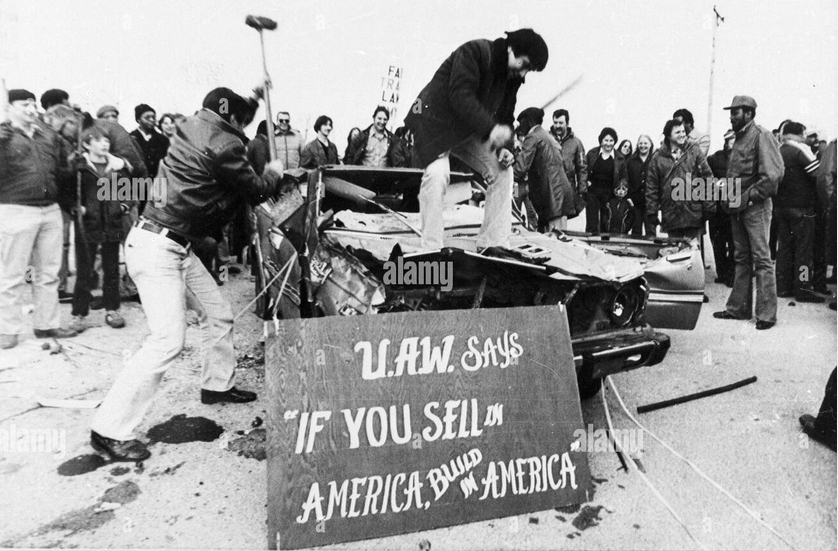
UAW workers pay to smash a Toyota
Attack on the Auto Industry
Beginning in the late 1970s, the Japanese started making serious gains on the American auto market. The proud American auto workers lost over 270,000 jobs from 1978 to 1981.4 This increase in unemployment built a resentment towards the Japanese and an additional enmity towards those of Asian descent. The United Auto Workers (UAW) even shifted this anger on members who bought imports. 5 The impacts on the automotive industry were the inspiration for the movie Gung Ho which we will now explore on how it portrayed this Auto Industry resentment.
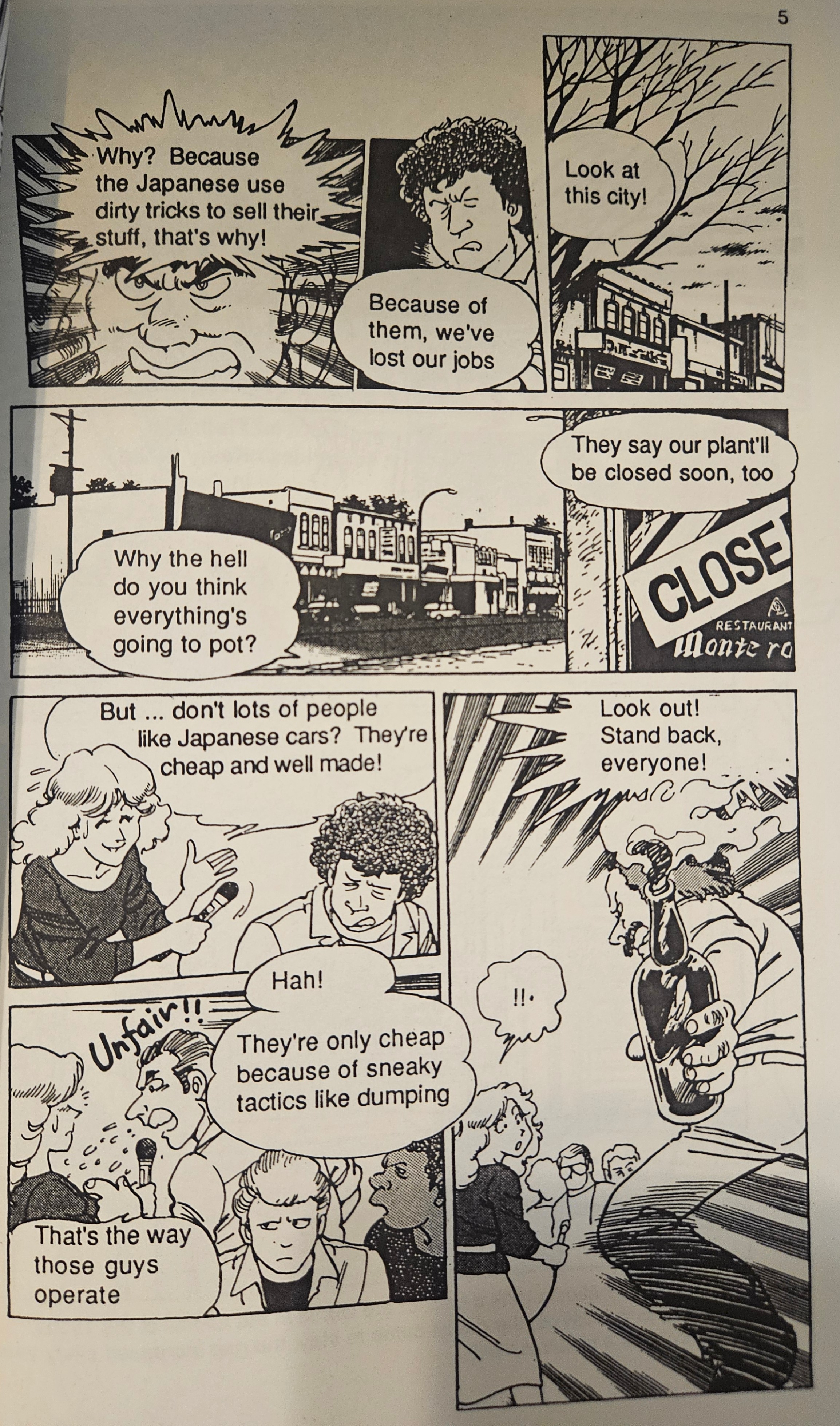
Anti-Japanese sentiment as shown in Japan Inc.
Gung Ho (1986) movie
In the Ron Howard 1986 movie Gung Ho, Hunt Stevenson shouts “The great old American do-or-die spirit, its alive, but they (the Japanese) got it. We better get it back and get it back fast.” 6 to a crowd of angry autoworkers who are about to lose their jobs for not meeting the 15,000 cars in a month Japanese set quota. Though Gung Ho is a comedy, the underlying issues, tension, and cultural differences which conflicted in the 1980s was a very real serious stake of employment and being able to care for your family. And providing for your family is often viewed as one of the corner stones of American values and independence. The movie portrays a group of ruff but lovable autoworkers who can step up to a meet an unreasonable Japanese demand that they make 15,000 cars in a month or risk being shut down.
But what does this movie reveal about America and Japan when we look past the comedy and feel-good moments?
The Trade War’s Cultural Impact through Gung Ho
The movie was not a major success and would get relegated as a movie that identified there is difference in our countries but not really attempted to address it in a serious matter. A review from Vincent Canby in the New York Times even acknowledges that these issues could have been explored more deeply but instead went for a safe, comedic portrayal that Americans are “ good natured slobs, soft from union codling” and “…The Japanese employers are uptight, traditionalist – efficiency-mad, authoritarian and worst of all, unable to relax and have a good time.” 7 This movie wasn’t a major success that changed the world but instead gives us a view of how 1980s Japanese and American Culture interacted together. Some of lines of the movie would be considered racist to this day and this movie shows some of the progress society has made to reduce racial disparagement and increase women in the work place as compared to 1986.
-
Wikimedia Commons, “Reagan Japanese Meetings London 1984,” https://commons.wikimedia.org/wiki/File:Reagan_Japanese_Meetings_London_1984.jpg ↩
-
Wayne M. Morrison and M. Angeles Villarreal, “Japan-U.S. Trade: A Chronology of Major Events, 1980–1990” (report, Washington, D.C.: Congressional Research Service, June 20, 1991), CRS-5. ↩
-
Morrison and Villarreal, “Japan-U.S. Trade: A Chronology of Major Events, 1980–1990”, CRS-6. ↩
-
AP Photo/StrIn this photo members of the United Autoworkers Local 588 of the Ford Motor Co. stamping plant wield sledgehammers and bars on a 1975 Toyota Corolla March 3, 1981, during a rally against buying foreign-made products in Chicago Heights, IL. Japanese auto and government officials in 2005 are worried about a replay of the “Japan-bashing” trade friction of the 1980s, when Toyota and others were blamed for stealing car sales and U.S. jobs, prompting outraged auto workers to smash Japanese cars in protest.https://www.alamy.com/in-this-photo-members-of-the-united-autoworkers-local-588-of-the-ford-motor-co-stamping-plant-wield-sledgehammers-and-bars-on-a-1975-toyota-corolla-march-3-1981-during-a-rally-against-buying-foreign-made-products-in-chicago-heights-il-japanese-auto-and-government-officials-in-2005-are-worried-about-a-replay-of-the-japan-bashing-trade-friction-of-the-1980s-when-toyota-and-others-were-blamed-for-stealing-car-sales-and-us-jobs-prompting-outraged-auto-workers-to-smash-japanese-cars-in-protest-ap-photostr-image526411750.html ↩ ↩2
-
Frank, Dana “Demons in the Parking Lot: Auto Workers, Buy American Campaigns, and the “Japanese Threat” in the 1980s”, Amerasia Journal, 28:3, 34 (2002) DOI:10.17953/amer.28.3.p74875252957n722 ↩
-
Gung Ho, Directed by Ron Howard (1986; 01:24:02). ↩
-
Canby, Vincent, “The Screen: ‘Gung Ho,’ Directed by Ron Howard.” New York Times, March 14 1986, https://libproxy.unm.edu/login?url=https://www.proquest.com/newspapers/screen-gung-ho-directed-ron-howard/docview/111082951/se-2. ↩