Getting Gung Ho
Japanese and American Cultural Differences in Business
As we examine the differences between Japanese and American business styles, what do we observe? We can see there is a clear distinction between them but is there more to these differences than just working hard and playing hard?
Business or Family? Is it Both?
There are aspects of the Japanese that Americans are not familiar with and Gung Ho (1986) uses this for laughs as the film shows men screaming together for some sort of foreign business ritual. But how real is Gung Ho’s portrayal of Japanese mentality as a polar opposite to American independence? The film attempts to portray, for comedic contrast, elements of the Japanese idea of Nihonjinron, literally “Japanese discussions”, which attempt to discuss the idea of the Japanese essence.
Sugimoto’s writing “Making Sense of Nihonjinron” talks about the desire to portray Japanese society as harmonious, integrated and consensual as part of the government’s desire to reduce class conflict and promote a Japanese culture that foreigners can’t be expected to comprehend.2 Sugimoto acknowledges that Nihonjinron proponents can sometimes carry racist and nationalistic ideas, which is built on a framework of Nationality, Ethnicity, and Culture (NEC). 3 Even Ruth Benedicts’s The Chrysanthemum and the Sword: Patterns of Japanese Culture. (1946) wrote how Japanese culture was built on meticulous rules and conventions and learning the hierarchy built on innumerable factors like age, sex, station, and familiarity. 4
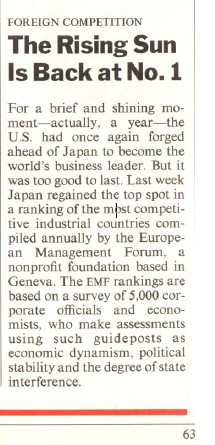
Times Magazine (1986) Describing Japanese competition
The American Autoworkers Union and Community Identity
Comparing Nihonjinron, and its view of nation, ethnicity, and Culture, to the idea that within the United States, there is some exceptionalism which just naturally makes American’s better than the competitors reveals that American feel their work and production is exceptional for no other reason than that it’s from the U S of A. The idea that the workers have lost this exceptionalism is part of the speech in Gung Ho that helps remind the workers what they are fighting for. 5 The community aspect that is found in Japanese Companies is compared against the identify of being in a Union helps give more power to its members in bargaining but tended to have “Big Labor” as an enemy view and anti-pioneering spirit of America by people like Barry Goldwater. 6 Union identity in labor gives the American worker a community identity that they belong to which differs from the Japanese sharing of their working identity in the corporation management. 7 The group honor is expressed in Gung Ho as Oishi Kazihiro drunkenly explains “I had to apologize to the workers for letting their production fall behind… A worker’s value is measured by the work The company is everything. Team!” But the cultural sentiment of this idea is lost when the scene shifts to drunken singing instead of exploring this idea more.
But the fact that the Japanese had efficient systems to run their business was not lost on American businesses and there were attempts to try to assimilate some of these ideas into American productivity. Gary Helfand explores these ideas in his article on Japanese Management techniques and the Japanese “experience a heightened sense of mutual understanding and intimacy.”8 This manifest in business with teams working together to avoid any sense of embarrassment or shame at not living up to the community identity such as mentioned above in the scene mentioned above. America’s cultural identity feels counter to this with the focus on individual responsibility.
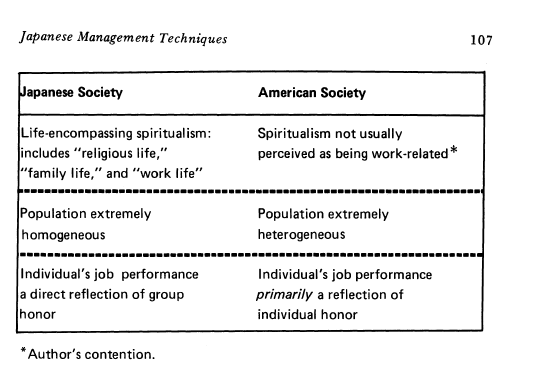
Helfand’s description on differences in management between America and Japan
Japan Inc and its Lasting Impact
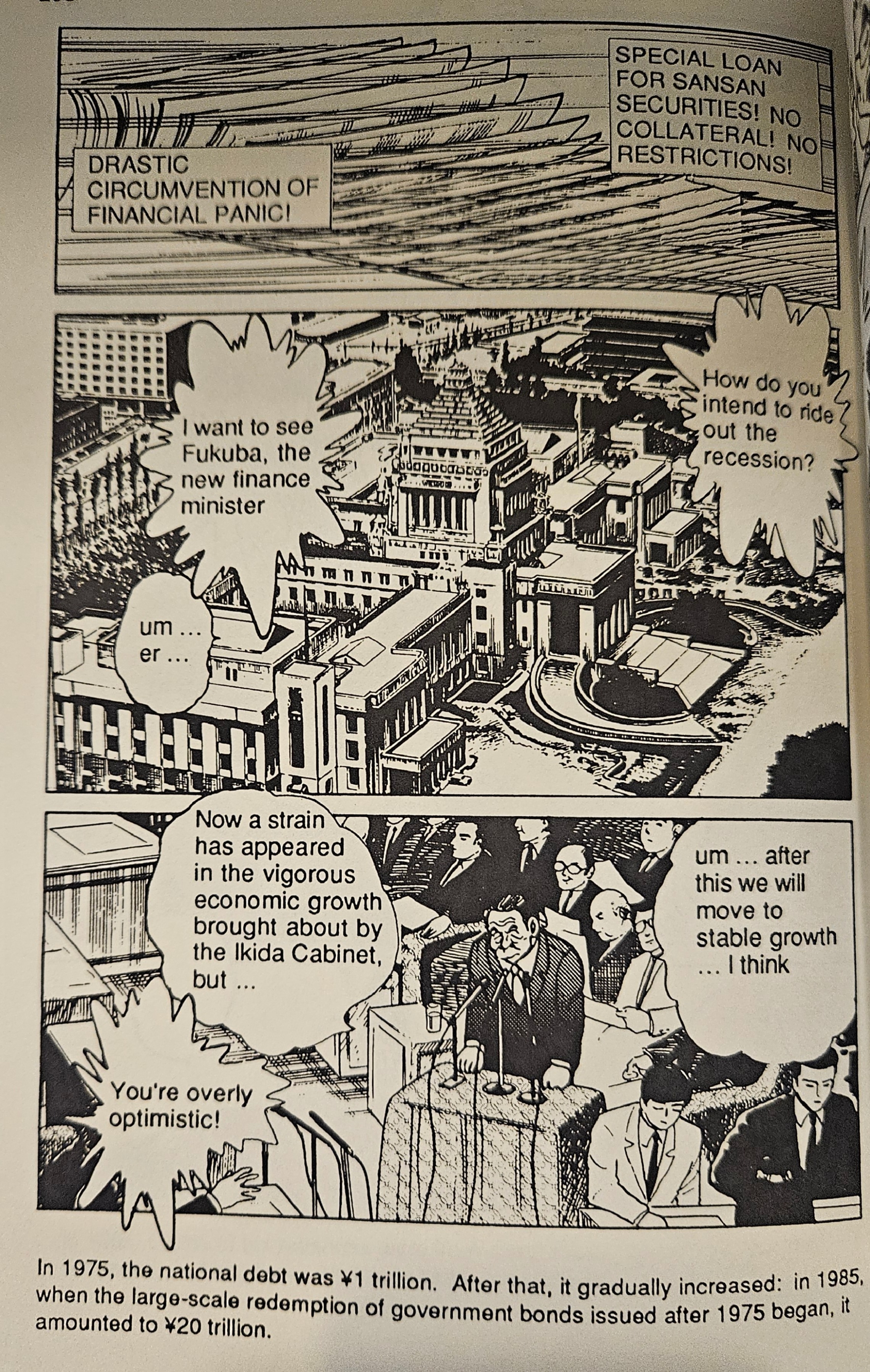
Japan Inc portrays the fear of economic uncertainty
Looking at the Japanese Manga “Japan Inc”, a sort of practical comic with economic and business information at the end of each section, there is an acknowledgement that Japan’s economic might had vulnerabilities. Japan Inc, as a “Benkyou Manga” (Study Comic) provided a way for high schoolers and college students to study economics while following a story about Japanese companies, Union battles and national Politicians working various trade deals. The Manga was a way to inform Japanese readers that, foreign and their own government can lie, manipulate their currencies, tariff products, and restrict trade as part of a Trade War to reach their national goals.
Business and Leisure
Though the Manga did portray the fears of the time that the US and Japan shared on unemployment and fair trade, the manga did not have a major impact on America. America keeps a separation between work and play, and even if a benkyou Manga could be instructive, it is likely to be viewed as childish due to the use of drawings. Mixing business and leisure is one of the differences of Japan and America, with Japanese Salarymen having a reputation for post work drinking that can end with sleeping on the street. Gung Ho shows the characters going out for drinks but the scene is more Americanized as a pep talk at the bar to get one’s spirit back up and not a community bonding session.
-
Howard, Ron, Director, Gung Ho. (Paramount, 1986), 00:00:40. ↩
-
Sugimoto, Yoshio. “Making Sense of Nihonjinron.” Thesis Eleven 57 (May 1999): 87. https://doi-org.libproxy.unm.edu/10.1177/0725513699057000007. ↩
-
Sugimoto, “Making Sense of Nihonjinron.”, 82. ↩
-
Ruth Benedict, The Chrysanthemum and the Sword : Patterns of Japanese Culture. (Boston: Mariner Books, 1989), 47-48, EBSCOhost. ↩
-
Gung Ho (1986), 01:24:02. ↩
-
Nicholas Buccola, One Man’s Freedom: Goldwater, King, and the Struggle over an American Ideal (Princeton, NJ: Princeton University Press, 2025), 99–100. ↩
-
Helfand, Gary Helfand, Gary. “The Applicability of Japanese Management Techniques in the American Public Sector: Some Cultural Considerations.” Public Productivity Review 7, no. 2 (1983): 107. https://doi-org.libproxy.unm.edu/10.2307/3380036. ↩
-
Helfand, Gary. “The Applicability of Japanese Management Techniques in the American Public Sector: Some Cultural Considerations.” Public Productivity Review 7, no. 2 (1983), 107-109, https://doi-org.libproxy.unm.edu/10.2307/3380036. ↩
-
Shotaro Ishinomori, JAPAN INC, Translated by Betsey Scheiner, University of California Press, Berkeley and Los Angeles, July 5th, 1988, 204-205. ↩
-
Reagan, Radio Address to the nation, April 25th, 1987. ↩